










There are women who are remembered for what they created, and then there are women who are remembered for who they became. Coco Chanel was both—but neither story begins where you expect it to.
It begins in absence.
In 1883, Gabrielle Chanel entered the world without ceremony, born into poverty in Saumur, France. Her childhood did not unfold with softness or security, but with a quiet instability that seemed to follow her like a shadow. Her mother, exhausted and ill, died when Gabrielle was still young. Her father, a man who drifted more than he stayed, left her at a convent orphanage and disappeared from her life with a finality that would shape everything that came after.
The convent was austere—cold stone walls, long corridors, a silence that pressed in on itself. There was no excess, no decoration, nothing unnecessary. The nuns dressed in black and white, their lives defined by discipline and restraint. Gabrielle grew up in that stillness, watching, absorbing, learning without realising that she was being formed by it.
Years later, she would deny this part of her life entirely. She would replace it with something softer, more acceptable—stories of a childhood spent with aunts, of a life that felt chosen rather than abandoned. But the truth lingered beneath everything she became. You can see it, if you look closely enough—in the stark palettes she loved, in the simplicity she defended, in the way she stripped things down until only their essence remained.
Before she was Chanel, she was a girl who learned early that survival required reinvention.
In her early twenties, she began to reshape herself. Paris, with all its noise and possibility, became the stage on which Gabrielle started to disappear and “Coco” began to take form. She sang in small cafés and cabarets—not with remarkable talent, but with enough presence to be remembered. The nickname “Coco,” light and playful, clung to her until it became something more permanent than her given name. Becoming the most powerful, household name in history, Coco Chanel.
It was around this time that men entered her life—not as a destination, but as passageways.
Étienne Balsan offered her an introduction to luxury, to a world that moved differently from the one she had known. In his château, she observed everything—the fabrics, the silhouettes, the quiet codes of wealth. She wore their clothes, studied their habits, but never quite belonged to them. There was always a distance, a sense that she was passing through rather than settling in.
Then came Arthur Capel—and with him, something far more dangerous than comfort: belief.
He recognised her not as an ornament, but as a force. Where others saw charm, he saw potential. He encouraged her to create, to build something that was entirely her own. It was Capel who financed her first boutique, who treated her ambitions not as a novelty, but as inevitability.
For a time, their relationship became the centre of her world. It was imperfect—he married another woman, bound by expectations Coco Chanel herself refused—but it was real. And for someone who had grown up without permanence, that mattered more than she would ever admit.
When he died suddenly in a car accident in 1919, something in her shifted irrevocably. Those who knew her spoke of a change—not dramatic, but unmistakable. She did not collapse under grief. She contained it. Compressed it. Transformed it into something sharper, more controlled.
Love, from that point on, would never again be something she trusted fully.
By then, however, she had already begun to change the world.
Her first shop on Rue Cambon did not announce itself loudly. It did not need to. At a time when fashion was defined by restriction—corsets pulled tight, fabrics layered heavily—Coco Chanel introduced something that felt almost radical in its restraint. She designed clothes that moved with the body instead of against it, using soft jersey fabrics that had previously been reserved for men’s undergarments.
It was not just a shift in style. It was a shift in philosophy.
Women did not simply want to look elegant—they wanted to live in their clothes. To breathe in them. To exist without being confined by them.
Coco Chanel understood this instinctively, perhaps because she herself had spent so much of her life resisting confinement of any kind.
The 1920s marked her ascent into something larger than a designer. She became an architect of modern femininity. The little black dress—once associated with mourning—became, in her hands, a symbol of understated power. Her tailored suits blurred the line between masculine and feminine, creating a new kind of elegance that felt both deliberate and effortless.
And then there was Chanel No. 5.
It was unlike anything that had come before it. Abstract, complex, impossible to define easily—it did not attempt to replicate a single flower, but rather an idea. When she was asked what a woman should smell like, Chanel’s answer was simple: “A woman.” It was both enigmatic and precise, much like everything she created.
But as her influence expanded, so too did the contradictions within her life.
She moved among artists and intellectuals, formed intense relationships, and built a world that appeared dazzling from the outside. Yet there remained, always, a distance. She revealed herself selectively, carefully constructing not only her image, but her narrative.
During World War II, that carefully constructed image fractured. Coco Chanel closed her business and became involved with a German officer during the Nazi occupation of Paris. Allegations of collaboration followed—complex, uncomfortable truths that do not sit easily alongside the legend she became.
And yet, they are part of her story.
After the war, she withdrew from Paris, spending years in relative exile in Switzerland. It might have been the end of her career—many believed it was. Fashion had moved on. New designers had taken her place.
But Chanel had never been interested in disappearing quietly.
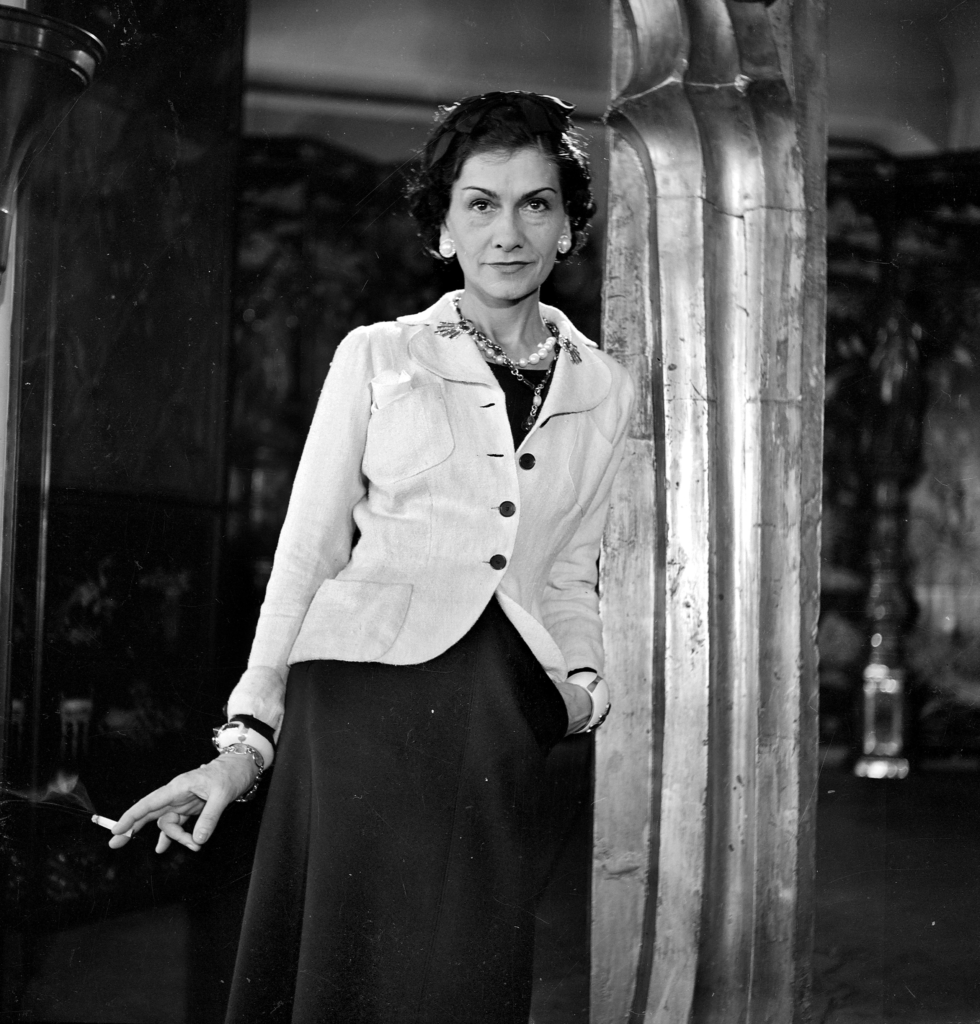
At seventy-one, she returned.
Older, yes—but undiminished. If anything, she was sharper, more certain. Her comeback was met with skepticism at first; critics dismissed her as outdated, a relic of another era. But Chanel had built her entire life on ignoring what others believed was possible.
Gradually, inevitably, the world turned back toward her.
Her designs—clean, structured, quietly powerful—felt relevant again. The Chanel suit, in particular, became a uniform for a new kind of woman: independent, self-possessed, uninterested in excess for its own sake.
She continued working almost until the end of her life.
In 1971, she died in her suite at the Hotel Ritz Paris, a place she had made her home for years. She was alone—but not in the way she had been as a child. This solitude felt chosen, controlled.
Fitting, perhaps, for someone who had spent her entire life refusing to be defined by anyone but herself.
What remains now is not just the brand, nor the designs, nor even the mythology that surrounds her name. It is something more enduring.
Coco Chanel did not simply create fashion. She created a way of being—one rooted in independence, in reinvention, in the quiet power of restraint.
And that is why she is still remembered.
Not because her life was perfect.
But because it never tried to be.
Share This Article